Queen Mother of the West 西王母
Xī Wángmǔ · Wade-Giles: Hsi Wang-mu
Deity 神
📜 Source Text 原文出处
西山经 · 玉山 · Classic of the Mountains: West
又西三百五十里,曰玉山,是西王母所居也。西王母其状如人,豹尾虎齿而善啸,蓬发戴胜,是司天之厉及五残。
Three hundred and fifty li further west lies Mount Jade, the dwelling place of the Queen Mother of the West. The Queen Mother's shape is like a human's, but she has a leopard's tail and tiger's teeth, and she is skilled at whistling-howls. Her hair hangs wild and unkempt, and she wears a jade sheng-ornament. She governs the pestilences of Heaven and the Five Ravages.
西海之南,流沙之滨,赤水之后,黑水之前,有大山,名曰昆仑之丘。……有人,戴胜,虎齿,有豹尾,穴处,名曰西王母。此山万物尽有。
South of the Western Sea, on the shore of the Flowing Sands, beyond the Red River and before the Black River, stands a great mountain called the Mound of Kunlun. ... There is a being there who wears a sheng-ornament, has tiger's teeth and a leopard's tail, and dwells in a cave; her name is the Queen Mother of the West. This mountain contains every imaginable thing.
From the Classic of the Great Wilderness: West (大荒西经) — the same goddess, still tiger-fanged and leopard-tailed, enthroned in her cave at Kunlun.
Modern location: Mythic; Mount Jade is traditionally placed in the far west, in the Kunlun range (modern Qinghai–Xinjiang region)
📝 Summary
The Queen Mother of the West (西王母) is one of China's oldest goddesses — and the most thoroughly transformed. In the Classic of Mountains and Seas, compiled around the 4th century BCE, she is a frightening deity of the far west: human in shape but leopard-tailed and tiger-fanged, wild-haired and jade-crowned, dwelling in a cave on Mount Jade and governing Heaven's pestilences and the Five Ravages. By Han times she had become the keeper of the elixir of immortality — the Huainanzi sends the archer Yi to beg it from her, and Chang'e steals it and flees to the moon. By the Six Dynasties she is the serene Queen Mother of legend: mistress of Kunlun, giver of peaches that ripen once in three thousand years, and sovereign of all female immortals.
🎨 Appearance
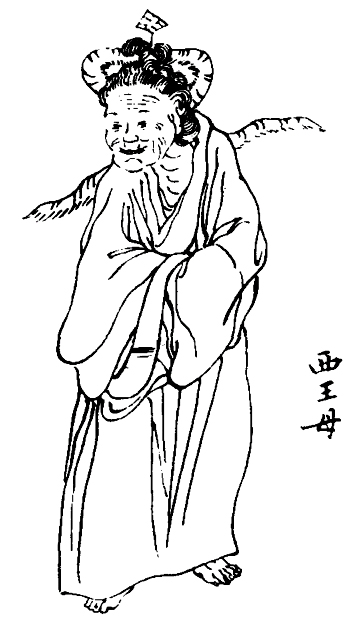
A goddess in human form — but with a leopard's tail lashing behind her and the fangs of a tiger in a human mouth. Her hair is a wild tangled mane, crowned with a sheng (胜), a jade hair-ornament. The early texts seat her in a mountain cave, not a palace; only later art softens her into an empress on a throne, peach in hand, with three blue birds bringing her food.
✨ Abilities
- Plague and punishment — 司天之厉及五残: she commands the pestilences of Heaven and the Five Ravages, the baleful star-powers of epidemic disease and mutilating justice
- The deathless elixir — keeper of the elixir of immortality; the Huainanzi (2nd century BCE, not the Classic) has the archer Yi beg it from her, and Chang'e steal it and flee to the moon
- Peaches of immortality — later tradition: her Kunlun orchard bears peaches that ripen once every 3,000 years; a single taste confers everlasting life
- Sovereign of Kunlun — mistress of the cosmic mountain ringed by the Weak Water River and the Flame Mountain, where the sun goes down and every rare thing under heaven is gathered
- Shaman's howl — 善啸: her piercing whistling cry carries across the western wilderness, announcing calamity
🏮 Symbolism
In the early stratum she is the terrifying west itself — the element metal, autumn, and death; later she becomes immortality incarnate: Kunlun's peaches, the moon-stolen elixir, the axis between heaven and earth, and head of all female immortals. Han tomb art made her the most-depicted goddess of the afterlife. Modern readings reclaim the first face: 20th–21st century scholarship (Max Dashu's shamanic-goddess essays, Suzanne Cahill's 1993 monograph) treats her as a surviving trace of China's ancient great goddess, and she now serves as a spirit-animal and tattoo emblem of sovereign feminine power and longevity, while strategy games like Age of Mythology: Tale of the Dragon keep her name in pop culture.
🎬 Cultural References
| Work | Year | Note |
|---|---|---|
| Mu Tianzi Zhuan (穆天子传) | Warring States, c. 4th–3rd century BCE | King Mu of Zhou journeys west and feasts her at Yaochi; she sings: 白云在天,山陵自出 ('White clouds are in the sky, the mountains rise of themselves') |
| Huainanzi (淮南子) · Lanming | Western Han, c. 139 BCE | Yi begs the elixir of immortality from her; Chang'e steals it and flees to the moon |
| Han Wu Nei Zhuan (汉武内传) | Six Dynasties period | She descends to Emperor Wu on the night of Double Seven and offers the peaches of immortality |
| Journey to the West (西游记) | Ming novel, c. 1592 | Wangmu Niangniang's Peach Banquet, crashed by Sun Wukong |
| Dynasty Warriors: Strikeforce 2 | 2010 | Xi Wangmu as a playable divine character (Koei) |
| Age of Mythology: Tale of the Dragon | 2016 | Xi Wangmu as a Mythic Age minor goddess of the Chinese pantheon |
The Leopard-Tailed Lady of Mount Jade
The Classic of Mountains and Seas does not describe a gentle queen. It describes a power: human in outline, but with a leopard’s tail, tiger’s teeth, and a howl she is “skilled at” sending across the mountains (善啸). Her hair is a tangled mane held by a sheng (胜) — a jade hair-ornament. And her office is grim: she “governs the pestilences of Heaven and the Five Ravages” (司天之厉及五残), the star-demons of epidemic and mutilating punishment. The second Classic passage still has her in a cave at Kunlun, at the world’s western edge, surrounded by the Weak Water River and a mountain where anything thrown in bursts into flame.
From Plague-Bringer to Giver of Eternal Life
The turning point comes from outside the Classic. The Huainanzi (淮南子, c. 139 BCE) sends the archer Yi to beg the elixir of immortality from her — and tells how Chang’e stole the drug and fled to the moon. In Han dynasty tomb art she is already China’s most popular goddess: enthroned, holding a scepter, served by three blue birds, with toad and nine-tailed fox attendant. By the Six Dynasties, the Han Wu Nei Zhuan has her descend to Emperor Wu on the Double Seventh carrying peaches that ripen once in three thousand years. The tiger fangs were quietly retired.
The Feast at Yaochi
Between the two faces sits a love song of empires. The Mu Tianzi Zhuan (穆天子传), a Warring States chronicle, sends King Mu of Zhou west with a hundred lengths of silk and a hundred catties of gold; at the Jasper Pool (瑶池) the Queen Mother sings to him: “White clouds are in the sky, the mountains rise of themselves; the road is long, mountains and rivers lie between us — may you not die, and come again” (白云在天,山陵自出). Sixteen centuries later, Journey to the West turns her banquet into the cosmic event Sun Wukong crashes. The cave-dwelling calamity goddess of the Classic had become the undisputed head of all female immortals — a promotion unique in Chinese myth.
🎲 D&D 5E: See the full stat block in the lore box below. CR 22 celestial (legendary), neutral — built to hold both faces at once: the plague-bringer of the Classic and the peach-queen of later empire.
🎲 D&D 5E Stat Block
AC 20 (divine), HP 385 (22d20+154), Speed 40 ft., fly 60 ft. (hover). STR 24, DEX 20, CON 24, INT 25, WIS 27, CHA 29. Legendary Resistance (3/day), Magic Resistance. Divine Spellcasting (Cha, DC 21): bane, contagion, dispel magic, greater invisibility, harm, mass cure wounds. Multiattack: two tiger-fang strikes, +13 (2d10+7 slashing), or one strike + Pestilent Gaze, +13, range 60 ft. (4d10+7 necrotic; the target can't regain HP until the end of its next turn). Five Ravages (Recharge 5-6): epidemic and fivefold mutilating justice fall on every enemy within 60 ft.; DC 21 Con save, 55 (10d10) necrotic damage and poisoned for 1 minute (save half, no poison; repeat the save at the end of each turn). Peaches of Immortality (1/day): allies within 60 ft. regain 77 (14d10) HP and are cured of all diseases, poisons, and curses; each gains 20 temporary HP and resistance to necrotic damage for 1 hour. Legendary Actions (3/round): move, tiger-fang strike, or Shaman's Howl (each enemy within 30 ft., DC 21 Wis save or frightened until the end of her next turn).