Nüwa 女娲
nǚ wā · Wade-Giles: nü-wa
Deity 神
📜 Source Text 原文出处
山海经 · 大荒西经 · Classic of the Great Wilderness: West
有神十人,名曰女娲之肠,化为神,处栗广之野,横道而处。
There are ten spirits, called the intestines of Nüwa. Having transformed into divinities, they dwell in the wilderness of Ligang, set squarely across the roadway.
The Classic of Mountains and Seas names Nüwa only here, in this strange epithet. The famous sky-mending myth reached us not through the Classic but through the Huainanzi — see the second passage below.
往古之时,四极废,九州裂,天不兼覆,地不周载,火焱而不灭,水浩洋而不息。于是女娲炼五色石以补苍天,断鳌足以立四极,杀黑龙以济冀州,积芦灰以止淫水。
In an age long past, the four pillars collapsed and the nine provinces split open. The sky could no longer cover everything, nor the earth bear up all things. Flames raged unquenched; floodwaters surged without end. Thereupon Nüwa smelted stones of five colors to patch the blue sky, severed the great turtle's legs to set the four pillars upright again, slew the black dragon to deliver the province of Ji, and heaped reed ash to stem the overflowing waters.
From the Huainanzi (2nd century BCE) — the famous sky-mending myth, preserved outside the Classic of Mountains and Seas.
Modern location: Mythic; later tradition associates her with the Zhuanxu region and temples across northern China (e.g., the Nüwa temple complex at Sheqiu, Hebei).
📝 Summary
Nüwa (女娲) is the serpent-tailed creator goddess of Chinese myth. The Classic of Mountains and Seas, compiled around the 4th century BCE, names her just once — as the 'intestines of Nüwa,' ten divine beings standing across a wilderness road. By the 2nd century BCE the Huainanzi credits her with mending the broken sky: smelting five-colored stones, severing a giant turtle's legs to re-support the heavens, slaying a black dragon, and damming the flood with reed ash. Later Han tradition makes her a potter who shaped humanity from yellow earth. Han tomb art pairs her serpent tail with her brother-consort Fuxi.
🎨 Appearance
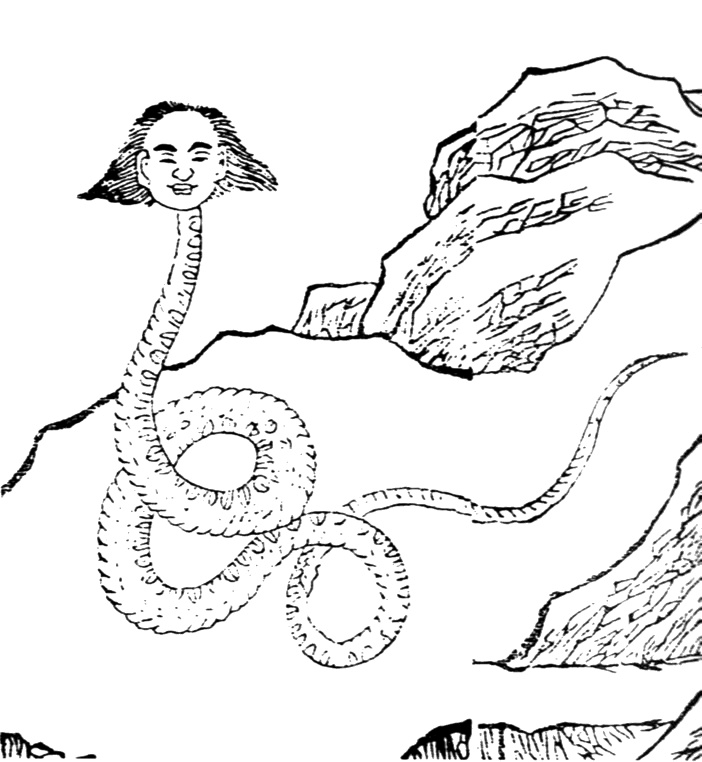
A regal goddess with the face and torso of a noblewoman, her lower body a long coiling serpent or dragon tail banded with iridescent scales. She holds or casts five-colored sky-mending stones; some images give her multiple arms, or surround her with the ten spirit-officials of her own entrails.
✨ Abilities
- Human-shaping — kneads figures from yellow earth and brings them to life; later ruler of clay and stone constructs
- Sky-mending — smelts stones of five colors to patch the heavens, and re-sets the four world-pillars with a giant turtle's legs
- Flood-quelling — banks the waters with reed ash; her serpentine earth-body parts the deluge
- Entrail divinities — her very intestines became ten road-guarding gods; her divine essence persists beyond death
🏮 Symbolism
Earth — the element of both the material people are made of and the goddess who makes them; the serpent tail = the fertile earth-body and the cosmic couple (sky-round compass, earth-square) with Fuxi; her Fuxi pairing became one of Han art's most widespread icons. Today she reads as the maternal emblem of creation, renewal, and mending what is broken.
🎬 Cultural References
| Work | Year | Note |
|---|---|---|
| Han pictorial stone tomb art (Han pictorial stone) | Han dynasty | Fuxi–Nüwa entwined tails, compass and square in hand — the classic icon, from Shandong and Henan tombs |
| Huainanzi (淮南子) · Lanming | Western Han, c. 139 BCE | The sky-mending myth's great telling |
| Chinese Paladin (仙剑奇侠传) | 1995 | Zhao Ling'er descends from Nüwa, introducing her to gamers |
| Honor of Kings (王者荣耀) | 2015 | Playable hero Nüwa |
| Ne Zha (animated film) | 2019 | The Spirit Pearl and Demon Orb derive from the primordial pearl of the Nüwa-told creation myth |
Ten Gods from Her Intestines
The Classic of Mountains and Seas mentions Nüwa exactly once, and the mention is among the strangest in the entire Classic: ten spirits called the “intestines of Nüwa,” dwelling squarely across the roadway of the wilderness of Ligang (栗广之野). She is already a remote, half-effaced figure by the time this stratum was written down around the 4th century BCE — an old goddess whose original stories were slipping from memory, leaving only this bewildering epithet behind.
The Mending of the Sky
The great rescue belongs to another book entirely. The Huainanzi (淮南子, presented to the Han court in 139 BCE) opens its “Discourse on the Obscure Sages” with a catastrophe: the four world-pillars shattered, the nine provinces split, unquenchable fire and unceasing flood. Nüwa’s four counter-measures answer in order — five-colored stones to patch the sky, a giant turtle’s legs to re-erect the pillars, a black dragon slain to save Ji province (冀州, the old heartland around the middle Yellow River), and reed ash heaped to stem the waters. A later annotator insists that the rulers of men afterward copied her deeds. The 1st-century CE skeptic Wang Chong already cites this account, so the myth was circulating early.
Shaping Humanity from Earth
Somewhere beneath the cosmic repair sits a quieter, more intimate creation. The Fengsu Tongyi (风俗通义) by Ying Shao (late Eastern Han) preserves the tradition that Nüwa shaped the first people from yellow earth, kneading each one in her own image; her strength ran short, so she dragged a cord through the mud and shook off the drops, and from those splashings came the thronging multitude. A much-quoted coda divides the rich from the humble by which method made them — a social satire that is now generally regarded as a later commentator’s embroidery. The original is lost and the passage survives only in quotation, so the wording above is a summary, not a quotation, of the tradition.
The Serpent Tail
The Nüwa everyone pictures — half woman, half snake — is barely in the early texts at all: the Classic calls her nothing more than a spirit (神), and even the Huainanzi repairs the sky without describing her body. It is Han dynasty tomb art that fixes her canonical form: pictorial stones from Shandong and Henan show her snake-tail braided together with her brother Fuxi’s, the two of them holding the compass and the square, the round heaven and the level earth. The Tang miscellany Duyizhi (独异志) records the matching story — Nüwa and Fuxi as the last beings after a great flood, brother and sister who married to repopulate the world. Fuxi rules heaven with the compass; Nüwa rules earth with the square; between them the world is set square and true. Later ages raised her to Wahuang (娲皇), the August Sovereign, and her temples still cluster across northern China — none grander than the temple city at Sheqiu in Hebei.
🎲 D&D 5E: See the full stat block in the lore box below. CR 22 celestial (legendary), lawful good.
🎲 D&D 5E Stat Block
AC 20 (divine), HP 405 (30d20+240), Speed 30 ft., swim 30 ft. STR 26, DEX 18, CON 27, INT 26, WIS 30, CHA 28. Legendary Resistance (3/day). Divine Spellcasting (Wis, DC 20): bless, earthbind, mending, stone shape, wall of stone. Multiattack: two divine hand strikes, +14 (2d10+10 force) each, or one hand strike + Bolt of Heaven, +14, range 300 ft. (3d10+10 radiant). Sky-Mending (Recharge 5-6): repairs the world — each ally within 60 ft. regains 70 (20d6) HP and ends all charms, fears, and curses; the cracked sky sheds five-colored light, giving creatures she chooses within 60 ft. half cover and resistance to all spell damage until her next turn. Raise the Pillars (Recharge 5-6): four stone pillars rise within 90 ft.; each creature within 10 ft. of one makes a DC 20 Dex save, 54 (12d8) bludgeoning and restrained (save half, no restraint). Human-Shaping (2/day): animates 1d4+2 human-shaped figures (clay scout stat block, 60 HP) that obey her.