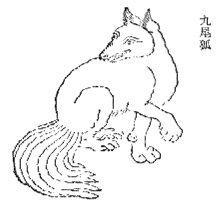
Nine-Tailed Fox 九尾狐
jiǔ wěi hú · Wade-Giles: chiu-wei hu
Auspicious Beast 祥兽
📜 Source Text 原文出处
南山经 · 青丘之山 · Classic of the Mountains: South
又东三百里,曰青丘之山,其阳多玉,其阴多青雘。有兽焉,其状如狐而九尾,其音如婴儿,能食人;食者不蛊。
Three hundred li further east lies Mount Qingqiu. Its southern slopes hold much jade; its northern slopes, much blue pigment. There is a creature there shaped like a fox with nine tails. Its cry sounds like a human infant, and it can devour people — yet those who eat its flesh are shielded from poison-hexes.
青丘国在其北,其狐四足九尾。
The land of Qingqiu lies to the north. Its foxes have four paws and nine tails.
From the Classic of Regions Beyond the Seas: East (海外东经)
Modern location: Traditionally placed near Yishui, Shandong Province
📝 Summary
The nine-tailed fox (九尾狐) is the most famous creature in the Classic of Mountains and Seas, first described around the 4th century BCE. Though the original text warns it 'can devour people,' later tradition reversed its image completely: by the Han dynasty it was an omen of peace and flourishing descendants, and by the Tang dynasty a supernatural beauty. It is the ancestor of Japan's kitsune and Korea's kumiho.
🎨 Appearance
A fox the size of a large dog, flame-red or golden-white fur, nine full tails fanning behind it. Its cry mimics a human baby — its hunting lure.
✨ Abilities
- Voice of the infant — lures victims by crying like a human baby
- Poison immunity — eating its flesh grants protection against gu hexes
- Omen-sight — appears only in times of peace and righteous rule
- Shapeshifting — later attribution: 1,000-year foxes gain nine tails and human form
🏮 Symbolism
Nine tails = many descendants (nine is the yang extreme); moral mirror from man-eater to seductress to reclaimed powerful feminine spirit; auspicious omen recorded in the Bamboo Annals.
🎬 Cultural References
| Work | Year | Note |
|---|---|---|
| Investiture of the Gods (封神演义) | Ming novel | Daji — the fox-possessed consort, source of the seductress trope |
| Naruto | 1999 | Kurama introduced Western audiences to the concept |
| League of Legends | 2011 | Ahri — likely the biggest modern exposure for Western audiences |
| Black Myth: Wukong | 2024 |
The Original Warning
The earliest stratum of the Classic of Mountains and Seas does not flatter the nine-tailed fox. It is a predator of the eastern mountains, and its infant-like cry is a hunting lure. Eating its flesh, however, grants immunity to gu poison — an early sign that this creature straddles the line between danger and blessing.
From Omen to Seductress
By the Han dynasty, the fox had become an auspicious sign. The Bamboo Annals records that a nine-tailed fox appeared to Yu the Great before he founded the Xia dynasty — a divine endorsement of his rule. Tang dynasty tales (Guangyi Ji) began the transformation into the beautiful fox-spirit, a lineage that runs through Pu Songling’s Strange Tales and into the present day.
One Fox, Three Mythologies
The nine-tailed fox is the shared ancestor of East Asia’s fox traditions: China’s huli jing, Japan’s kitsune, and Korea’s kumiho. Each culture drew a different moral from the same animal — wisdom in Japan, danger in Korea, and a shifting mirror of virtue and vice in China.
🎲 D&D 5E: See the full stat block in the lore box below. CR 5 celestial (shapechanger), neutral good.
🎲 D&D 5E Stat Block
AC 14 (natural), HP 105 (10d10+50), Speed 50 ft. STR 16, DEX 17, CON 20, INT 14, WIS 16, CHA 19. Shapechanger, Innate Spellcasting (DC 15): charm person, invisibility, suggestion. Multiattack: bite +6 (1d10+3) + nine-tail lash +6 (2d6+3, DC 15 Str or prone). Foxfire (Recharge 5-6): 20-ft cone, DC 15 Dex, 21 (6d6) fire damage.
Related Creatures
🌍 Real-World Theories
Was the Nine-Tailed Fox based on a real animal? Examine the claim, the evidence, and the verdict →