Qiongqi 穷奇
qióng qí · Wade-Giles: ch'iung-ch'i
Fierce Beast 凶兽 · Four Perils 四凶
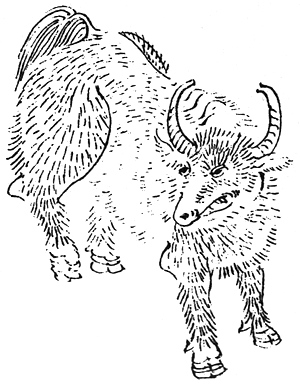
📜 Source Text 原文出处
山海经 · 海内北经 · Classic of Regions Within the Seas: North
穷奇状如虎,有翼,食人从首始,所食被发,在蜪犬北。一曰从足。
Qiongqi has the shape of a tiger and bears wings. It devours people, beginning with the head; its victims are found with their hair hanging loose. It dwells north of the Tào dog. One account says it begins with the feet.
又西二百六十里,曰邽山,其上有兽焉,其状如牛,猬毛,名曰穷奇,音如獆狗,是食人。
Two hundred sixty li further west stands Mount Gui. On it dwells a beast shaped like an ox and covered in hedgehog quills. Its name is Qiongqi, its cry like the howling of a hound — and it devours people.
少皞氏有不才子,毁信恶忠,崇饰恶言,靖谮庸回,服谗搜慝,以诬盛德,天下之民谓之穷奇。
The house of Shaohao had a worthless son who broke faith and despised loyalty, exalting and embellishing wicked words. At ease with slander and practiced in deceit, he wielded backbiting and gathered up evil, the better to smear great virtue — and so the people of the world named him Qiongqi.
From the Zuo Zhuan — Qiongqi as the evil son of the Shaohao clan, later fused into the Four Perils.
Modern location: Mount Gui — traditionally placed near the Gansu–Shaanxi border region
📝 Summary
Qiongqi (穷奇) is a man-eating beast of the Classic of Mountains and Seas, first described around the 4th century BCE in two contradictory forms: a winged tiger that devours people head-first, and a hedgehog-bristled ox on Mount Gui with the cry of a howling hound. A 3rd-century BCE chronicle, the Zuo Zhuan, recast Qiongqi as a corrupt son of the Shaohao clan, and Han texts canonized it as one of the Four Perils. The Han compendium Shen Yi Jing gave it its most infamous trait: hearing a dispute, it eats the party in the right.
🎨 Appearance
Two irreconcilable forms in the original texts: a winged tiger of the far northern wastes, or an ox on Mount Gui covered in hedgehog quills. The second account gives it the cry of a howling hound; both agree it devours people, beginning at the head.
✨ Abilities
- Winged flight — the tiger form rides the storm-winds of the northwest
- Head-first hunger — devours its victims beginning at the skull
- Quill-hide — the ox form bristles with hedgehog spines that turn aside blades
- Bane of the righteous — understands human speech, and hunts whoever is in the right (later attribution)
🏮 Symbolism
Justice inverted — punishes the righteous and rewards the wicked; one of the Four Perils (四凶) exiled by Shun; offspring of the Guangmo, the northwest wind, in the Huainanzi.
🎬 Cultural References
| Work | Year | Note |
|---|---|---|
| Zuo Zhuan (左传) | 3rd century BCE chronicle | Qiongqi as the evil son of Shaohao — the root of the Four Perils tradition |
| Huainanzi (淮南子) | Han text | Makes Qiongqi the offspring of the Guangmo, the northwest wind |
| Shen Yi Jing (神异经) | Han compendium | Source of its inverted justice: it eats the party in the right and rewards the wicked |
| Records of the Grand Historian (史记) | Han history | Shun banishes Qiongqi and the other three Perils to the four frontiers |
Two Faces, One Monster
The Classic of Mountains and Seas never reconciles its two Qiongqis. The Regions Within the Seas (海内北经) describes a winged tiger that devours people head-first — one variant text says beginning at the feet — leaving its victims with hair hanging loose. The Mountains of the West (西次四经) sends travelers 260 li further west to Mount Gui, where a beast shaped like an ox, bristling with hedgehog quills and howling like a hound, answers to the same name. Two bodies, one monster: the compilers apparently stitched together regional traditions without choosing between them.
From Bad Son to Bad Omen
The Zuo Zhuan (左传), a chronicle compiled in the 3rd century BCE, gives Qiongqi a human origin: a worthless son of the Shaohao clan who broke faith, hated loyalty, and trafficked in slander until the people of the world named him for the beast. By Han times this had fused with the legend of the “four evil clans” that the sage-king Shun exiled to the four frontiers. The Huainanzi (淮南子, c. 139 BCE) supplies a fitting lineage: Qiongqi is the offspring of the Guangmo (广莫), the northwest wind — one reason later bestiaries file it under the element of wind.
The Beast That Punishes the Righteous
The Shen Yi Jing (神异经), a Han compendium attributed to the court wit Dongfang Shuo, completes the inversion. This Qiongqi understands human speech: when it hears a quarrel, it devours whichever party is in the right; hearing of loyalty and good faith, it bites off the speaker’s nose; hearing of cruelty, it slaughters an animal and carries the meat to the wicked as a gift. Justice turned perfectly upside down — and a warning that in a disordered age, virtue itself becomes prey.
One of the Four Perils
With Taotie (饕餮), Hundun (混沌), and Taowu (梼杌), Qiongqi anchors the roster of the Four Perils — the anti-pantheon a ruler must exile to keep the realm in order. If the Four Divine creatures (四灵) embody harmony, the Four Perils embody its opposites: chaos, gluttony, obstinate ignorance, and perverted justice.
🎲 D&D 5E: See the full stat block in the lore box below. CR 7 monstrosity, chaotic evil.
🎲 D&D 5E Stat Block
AC 15 (natural), HP 168 (16d10+80), Speed 40 ft., fly 60 ft. STR 18, DEX 16, CON 20, INT 8, WIS 14, CHA 10. Flyby, Keen Smell, Magic Resistance. Multiattack: bite +6 (2d10+4 piercing) and 2 claws +6 (2d8+4 slashing). Devour the Headstrong (Recharge 5-6): one creature Qiongqi can see within 10 ft., DC 15 Wis save, 31 (7d8) psychic damage and the target is frightened until the end of its next turn; on a success, half damage only.