Taotie 饕餮
tāo tiè · Wade-Giles: t'ao-t'ieh
Fierce Beast 凶兽 · Four Perils 四凶
📜 Source Text 原文出处
山海经 · 北次二经 · Classic of the Mountains: North, Part II
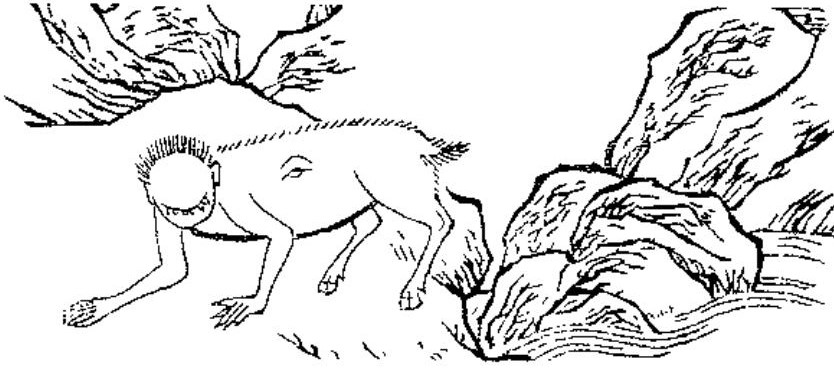
又北三百五十里,曰钩吾之山,其上多玉,其下多铜。有兽焉,其状如羊身人面,其目在腋下,虎齿人爪,其音如婴儿,名曰狍鸮,是食人。
Three hundred and fifty li further north stands Mount Gouwu. Its upper slopes hold much jade; its lower slopes, much copper. A creature dwells there whose body is that of a ram and whose face is human. Its eyes sit beneath its armpits; it has the teeth of a tiger and the claws of a human. Its voice is like an infant's, and it is called the Paoxiao. It devours people.
缙云氏有不才子,贪于饮食,冒于货贿,侵欲崇侈,不可盈厌,聚敛积实,不知纪极,不分孤寡,不恤穷匮,天下之民以比三凶,谓之饕餮。
The Jinyun clan had an unworthy son: greedy in food and drink, covetous of goods and bribes, his appetites swelling ever more extravagant, never sated, hoarding and amassing wealth without measure or limit. He shared nothing with widows and orphans and cared nothing for the poor and destitute, so the people of the world ranked him alongside the Three Villains and called him Taotie.
From the Zuo Zhuan (7th century BCE) — Taotie named as the greedy son of the Jinyun clan, later fused into the Four Perils.
Modern location: Mount Gouwu — traditionally placed in the Shanxi region
📝 Summary
The taotie (饕餮) is a man-eating beast of the Classic of Mountains and Seas (compiled c. 4th–1st century BCE), described in its northern chapters as a sheep-bodied, human-faced creature with eyes beneath its armpits. By the 7th century BCE, the Zuo Zhuan had made 'Taotie' the name of a notoriously greedy man, later counted among the Four Perils. From the Shang dynasty (c. 1600–1046 BCE) on, its glaring face — the 'taotie mask' — decorated bronze ritual vessels, turning the beast into China's enduring emblem of insatiable appetite. Modern Chinese still calls a lavish feast a 'taotie banquet' and a gourmet a 'laotao'.
🎨 Appearance
A beast with the woolly body of a ram, a human face, tiger fangs and human claws, and its eyes set in the hollows of its armpits. Its cry sounds exactly like a human infant.
✨ Abilities
- Voice of the infant — wails like a human baby to lure prey close, the same trick as the nine-tailed fox
- Armpit eyes — eyes set beneath its forelegs watch in every direction; nothing ambushes it
- Rending jaws — tiger teeth and human claws built for tearing apart armed prey
- Bottomless gullet — swallows people whole and is never sated; its hunger is its whole nature
🏮 Symbolism
Insatiable greed — appetite for food and for wealth with no limit; the bronze mask shown head-without-body reads as a warning that devouring without measure ends in devouring oneself; parent of the modern terms 'taotie feast' (饕餮盛宴) and 'laotao' gourmand (老饕).
🎬 Cultural References
| Work | Year | Note |
|---|---|---|
| Zuo Zhuan (左传) | 7th century BCE | names Taotie the greedy son of the Jinyun clan, later one of the Four Perils |
| Lüshi Chunqiu (吕氏春秋) | 3rd century BCE | explains the bronze taotie as a head without a body — in devouring others it consumed itself |
| Houmuwu Ding (后母戊鼎) and other Shang bronzes | Shang dynasty | ritual ding and zun vessels wrapped in the symmetrical 'taotie mask' |
| The Great Wall (长城) | 2016 | Zhang Yimou's film turned the taotie into a swarm of invading monsters for Western audiences |
The Man-Faced Beast of Mount Gouwu
The northern chapters of the Classic of Mountains and Seas (compiled roughly 4th–1st century BCE) record a creature called the Paoxiao (狍鸮) on Mount Gouwu: the body of a ram wearing a human face, tiger’s teeth, human claws — and, most unnervingly, its eyes set in the hollows of its armpits. Its cry is the wail of a human infant, the same lure the nine-tailed fox sets in the eastern mountains; anyone who follows the sound into the hills does not come back. The fourth-century commentator Guo Pu was the first to declare that this paoxiao was none other than the Taotie of the chronicles, and his identification stuck.
From Monster to Moral Verdict
By the 7th century BCE the name had escaped the mountains. The Zuo Zhuan chronicle fastens Taotie onto the gluttonous son of the Jinyun clan — a man so greedy for food, bribes, and hoarded wealth that he shared nothing with widows or orphans — and the label hardened into the standard word for rapacious appetite. Later tradition folded him into the Four Perils (四凶): Qiongqi, Hundun, and Taowu, each a human vice given a monster’s body.
The Face That Ate the Bronze Age
The taotie’s face was famous before the chronicle was ever written. From the Shang dynasty (c. 1600–1046 BCE), the great ritual ding and zun vessels — most spectacularly the Houmuwu Ding — were wrapped in the horned, fanged ‘taotie mask,’ split in perfect symmetry across the vessel’s flanks. The Lüshi Chunqiu (3rd century BCE) supplies the gloss: the bronze taotie has a head but no body, because in devouring people it finally consumed itself. The warning softened over the centuries — modern Chinese now uses ‘taotie feast’ (饕餮盛宴) to praise an extravagant banquet and ‘laotao’ (老饕) to honor a devoted gourmet.
The Monster Hollywood Met
For most Western viewers, one film defines the beast: Zhang Yimou’s The Great Wall (2016), in which swarm-minded taotie pour out of the mountains every sixty years to devour everything in their path. The creature design keeps the antique anatomy — eyes clustered on the shoulders, a body low and ravenous — and scales it into a blockbuster horde.
🎲 D&D 5E: See the full stat block in the lore box below. CR 9 monstrosity, chaotic evil.
🎲 D&D 5E Stat Block
AC 16 (natural), HP 168 (16d12+64), Speed 40 ft. STR 20, DEX 12, CON 18, INT 6, WIS 13, CHA 8. Magic Resistance, All-Around Vision (its armpit eyes prevent it from being surprised or flanked). Multiattack: two claws +9 (2d8+5 slashing) and one bite +9 (2d12+5 piercing). Devour (Recharge 5-6): the taotie makes one bite attack with advantage; on a hit, the target takes an extra 22 (4d10) piercing damage and must succeed on a DC 16 Strength save or be swallowed.